Why Is Creating Effective, Engaging Activities for Childcare Ell Families Important
Guide for Engaging ELL Families: 20 Strategies for School Leaders
How can schools class strong partnerships with ELL and immigrant families? How can school leaders make that happen? The following tips provide some ideas for getting started! These strategies announced in Engaging ELL Families: 20 Strategies for School Leaders.
The following strategies offer tips for edifice relationships with the families of English linguistic communication learners (ELLs), getting to know their strengths and stories, and creating a welcoming surroundings.
Supporting immigrant families
For related ideas, meet the following:
- Ten Strategies for Supporting Immigrant Students and Families
- How to Support Immigrant Students and Families: Strategies for Schools and Early Childhood Programs
one. Learn about your ELL population
A. What you lot need to know
Learning almost your ELL families provides an important foundation for everything else you lot practise at the schoolhouse. Even basic information nigh students' ethnic and linguistic backgrounds, or the situations from which they take come, can aid you match students with the appropriate services and programs.
B. Reflection
Answer the following questions about your ELL families using a KWL chart:
- What do you know well-nigh your ELL students and families?
- What do you want to larn?
- Who on the staff works most closely with your ELL families?
- What would exist valuable for your schoolhouse-wide staff to know?
C. Strategies
If you exercise not yet know this information almost your ELLs, find out:
- What countries your families come from
- How many of your ELLs were born in the U.Southward.
- What languages they speak (which may exist at least two or three!)
- If families who speak the same linguistic communication, such equally Spanish, come from different countries or different regions within the same country
- The educational background of families and the school arrangement of their countries
- If whatever of your ELLs are refugees or students with interrupted formal education
- If your families take experienced war or some other traumatic event such as a natural disaster.
In club to learn more than about your ELL families:
- Commencement with your ELL/bilingual educators. These individuals are an of import resources whose feel working with ELL students and families can benefit the entire school community - and they volition capeesh the opportunity to share their expertise!
- Detect out what resource are available from the district and community. This may include helpful background information as well as a network of interpreters.
- Enlist a knowledgeable staff member, community member, or parent. If yous find such a person, examine his/her background every bit information technology relates to what you need. For case, you may know a Somali young adult who is bilingual merely doesn't recollect Somalia. He may be more helpful equally an interpreter than every bit a liaison for Somali families who have just arrived in the U.S.
- Inquire the families. You may want to include some questions in your home language survey or a very bones questionnaire that ELL parents fill out with an interpreter during educatee enrollment.
Note: Remember that your ELL population is not homogeneous. The child of a migrant worker from Mexico and the child of a teacher from Mexico probably won't have the same educational and economic needs. Learn what y'all can most each kid's unique circumstances to the extent possible.
D. Example
- An administrator from Minnesota wanted to meliorate understand the needs of the children who were arriving at her school directly from Kenyan refugee camps. She wrote a grant that enabled her to travel to Republic of kenya and visit the camps from which they were coming. What she learned at the camps was non only helpful for her; it was helpful for the entire staff. Based on her feel, she was likewise able to prevent some major misunderstandings around discipline issues. (Related video: Agreement Pupil Background, Dr. Cynthia Lundgren)
Resources
- Learn more about special populations of students
- Go to know your students and families
ii. Integrate cultural traditions of your ELL families throughout the school
A. What you lot need to know
Becoming familiar with and including the cultural traditions of your ELL families within the larger schoolhouse customs not but enhances your ability to create a welcoming and respectful school environment — it has practical considerations as well. These include:
- Scheduling: Scheduling effectually important cultural or religious holidays will assistance forbid big numbers of students from missing important instruction time, exams, and school events.
- Classroom opportunities: Familiarity with ELL families' cultural traditions will provide teachers a base from which to build upon ELLs' background knowledge, create educational opportunities for other students, and foster a sense of respect amidst students for their peers.
- Improved communication: Learning about your ELL families' traditions may help avoid miscommunication or cultural blunders that can damage a budding relationship.
B. Reflection
What are your ELLs' cultural behaviors and values? Which celebrations and holidays practice they observe? How does your staff experience near the changes in your school population? How do they experience well-nigh working with ELLs?
C. Strategies
- Avoid scheduling important events such as conferences or tests on major holidays and celebrations that large numbers of students are probable to miss.
- Share these dates with the entire staff.
- Share information about cultural celebrations with teachers then that they are able to positively back up them and comprise them into lessons. Even a simple memo that explains why students will be out and offers some ideas for follow-up activities will exist helpful. (Encourage teachers to first with children's books, which oftentimes have background data and activities, such as these titles nigh Ramadan, Chinese New year's day, and Día de los muertos.)
- Larn almost, recognize, and celebrate special events or holidays throughout the schoolhouse.
- Invite parents to share food, activities, and music at school events and in the classroom.
- Encourage students to share traditions in schoolhouse assemblies, talent shows, potlucks, and fairs.
- Offer food that reflects the cultural influences of your families on the cafeteria menu.
- Exist mindful that students who are fasting may be less energetic in the afternoon. If possible, avoid school-broad parties or nutrient-centered activities during these times.
Notes: Staff may resist the changes happening around them, and they may be uncomfortable discussing those changes. Such was the case of a school custodian in Minnesota who asked a receptionist "why they (the Muslim students) get special days off and we can't even celebrate Christmas." Dr. Lundgren explains the importance of having an open up, non-threatening conversation with the entire staff that acknowledges the challenges of serving a new ELL population and explores steps the school can take to address those challenges. (Related video: Cultural shifts, Dr. Lundgren)
You may find it helpful to bring in a neutral, outside party who specializes in cross-cultural education and advice in order to assist moderate these conversations if they seem particularly fraught with tension. An open up dialogue with a professional will give your staff the tools they demand to adjust to the new reality and create a more positive, welcoming environment for anybody in the school.
D. Examples
- Storyteller Lucía González remembers a storyteller-in-residence programme she led at a Colorado elementary school. The program was going to culminate with a Castilian-language story hour for the Latino families at the school. On the nighttime of the event, the weather condition was bad, and few people had arrived every bit she was getting ready to commencement. Seeing the pocket-size crowd, the primary turned to her and said, "Don't worry if they don't come up, considering usually they don't come." At 7:00 p.m., however, the parents began to make it, led past the excited children who had heard her stories. (Related video: A dream come true - The Storyteller's Candle, Lucía González)
- A group of Muslim students at Wood Heights Collegiate Plant in Ontario approached primary Jim Woolley about finding a identify to pray within the school. After working with an clearing settlement worker and local imam, the school reserved a classroom in which students pray on Friday afternoon later the school is closed. They use the classroom and so lock the door when they finish. Co-ordinate to Mr. Woolley, it doesn't cost the school annihilation and it doesn't require supervision. "We trust them," he said (D'Amato, 2011).
3. Create a welcoming environment for families
A. What you need to know
A welcoming environment tin make a tremendous difference for all families, including ELL families. Entering a friendly, vibrant atmosphere lets families know that the schoolhouse is "an integral function of the community" (Houk, 63) and that they are valued members of that customs. This is especially important for immigrant families who may be intimidated by the formal school environment and the English linguistic communication needed to participate.
Another way to think of this is to keep your ELLs visible. ELLs are often treated as an invisible minority, simply ELLs and their families should "see themselves" throughout the school:
- On the walls, through student work and photos
- In the classroom, with books and lessons that incorporate their experiences and traditions
- In school-wide cultural activities
- In the faces of staff and volunteers who come from similar backgrounds.
B. Reflection
Imagine that you have arrived in a new country where you don't speak the linguistic communication and where you lot will be enrolling your child in a local school. Recall well-nigh arriving at the schoolhouse for the first time, only to observe that no one at the school speaks English. Imagine the feeling of leaving your child in the hands of people with whom you tin can't communicate. At present envision, instead, that someone who speaks English language greets you at the door, and you encounter a picture of an American flag in the forepart hallway. What might you lot be able to accomplish as a parent in the second state of affairs that you wouldn't in the start?
C. Strategies
- Make sure parents know how to get into the building, particularly if doors are usually locked during the school day.
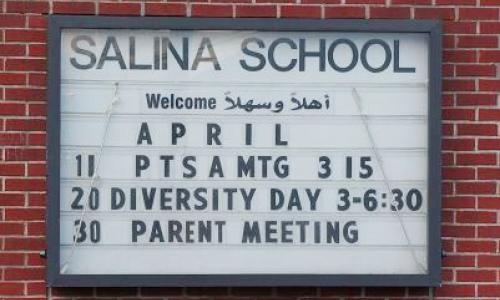
- Post signs in multiple languages.
- Display pupil work on the walls.
- Brandish student and family photos on the walls.
- Display the maps and flags of your students' native countries.
- Display a large map in the forepart anteroom where parents can marking their native countries with a pivot.
- Enlist a bilingual morning greeter to welcome students and families.
- Ensure that your bilingual staff and volunteers are visible throughout the building.
- Create a parent room (such equally a lounge or classroom) with bilingual information and mag subscriptions, a bulletin board, a lending library, and a figurer (Houk, 58, 63).
- Include bilingual books in the schoolhouse library and classrooms.
- Consider playing music in the front end entryway or vestibule.
- Encourage teachers to create a welcoming environment inside the classroom.
D. Instance
- At Lincoln Options School, in Olympia, Washington, there are photos of the entire school community - students, staff, and families - to greet guests in the forepart anteroom. Each year, the schoolhouse hires a lensman to nourish its annual back-to-school barbeque and take informal photos (Houk, 9). In addition, student work is posted throughout the building (xvi).
Resources
- Allow all families know that they are welcome
- Place pupil and family unit strengths
4. Make a personal connection with families
A. What you need to know
Getting to know ELL families helps build an important relationship based on trust, which in plow can pave the way to educatee success. This approach is most effective when the communication is personal and face-to-face (Hori, 40; Alford 85). While it will require additional time and effort, building a more personal relationship with ELL families early in the twelvemonth will yield large dividends throughout the rest of the twelvemonth (Hori, 40). Information technology will also provide opportunities for the staff to meet only how deeply ELL parents care about their children'southward educational activity.
Indeed, as Dr. Lundgren notes, many ELL families have come to this country with the hopes of offering their children a better future, and they are eager to talk with their children's teachers well-nigh what they can practice to assistance their child exist successful. (Related video: A amend life, Dr. Lundgren)
B. Reflection
What are the challenges in meeting your ELL families personally? What are some ways to facilitate more personal interaction?
C. Strategies
- Concord a special back-to-school consequence or picnic for ELL families in which they accept time to meet you, other school leaders, their children's teachers, and school staff.
- Create a welcome DVD in multiple languages. This may even be a smashing student projection!
- Provide staff the opportunity to larn some common phrases in your families' languages, as well every bit cultural gestures.
- Visit local neighborhoods to run across families.
- Connect new families with a contact person who speaks their language every bit soon as they enroll in the school for guidance and information (Houk, 66).
- Create an "ambassador" program in which students and parents are trained to give tours.
D. Examples
- Educator Maricela Rincon in Las Cruces, NM calls a different parent every mean solar day to share something positive about his/her kid. According to Rincon, some parents say, "This is the start time I've had a positive phone call about my child." While Rincon is enthusiastic about the calls, they weren't her thought - they were required past the school principal (Flannery, NEA.org). (Related video: Parent outreach in high school, Bobbi Ciriza Houtchens)
- A group of school educators asked experts from a local university to aid them learn more near their ELL community. After the initial conversation, it was articulate that the school leaders assumed that the parents' lack of input, communication, and attendance reflected a lack of interest in their child'south didactics. Afterward getting some parent input, however, the educators discovered that the parents weren't enthusiastic about the school messages inviting them to events. They didn't feel that the events were planned with them in mind, and the letters seemed very impersonal. The parents didn't see the messages every bit the invitations they were intended to be. They expressed preference for more personal contact and invitations from the school, at least in the start of the year, in lodge to establish a strong relationship (Alford and Niño, 81-82).
- This is an excerpt from a parent letter of the alphabet to the principal virtually her beginning visit to her kid's schoolhouse:
I was very surprised when we were non able to speak to Lupe's teacher, Mrs. Gibbons, individually. In Guatemala nosotros all knew the teachers and the teachers knew the parents...We do not know anyone here nor does anyone know us...we would have liked to tell Mrs. Gibbons how much we value education (Amaya, 53).
5. Show that you value families' native languages
A. What y'all need to know
As the school leader, i of your near important roles is defining the terms of engagement when it comes to ELLs' native languages. Do yous see those languages as a barrier or an asset? Do you see native linguistic communication literacy and pedagogy equally a crutch or a tool?
Unfortunately, the political climate oftentimes dictates district or state policy regarding native linguistic communication support (Wright, 51), and of import information regarding the value of native linguistic communication literacy is often left out of the fence. Oftentimes, ELL parents themselves are the party most resistant to promoting their native linguistic communication at home or in school because they believe information technology will hinder their child's ability to acquire English. While this belief is entirely understandable, the inquiry is clear that potent native language skills contribute to ELLs' academic success throughout their educational activity - in their native language and in English.
What can you do to navigate this tricky terrain and encourage the connected development of students' native language skills, as well every bit biliteracy and bilingualism for all students?
- Respect parents' intentions: It is critical to assure parents that you respect their wishes and goals for their children; you tin can do so by explaining that stiff native linguistic communication skills will help their children learn English. This reassures parents that you have their children's best interests at heart and that you view their native language as an nugget, not an obstacle.
- Encourage native language use at habitation: Don't miss any opportunity to encourage parents to use their native language, whether information technology'south through reading (which will help their children'southward reading skills in English language) or taking the time to talk to each other at dwelling house. Wait for ways that the schoolhouse can back up this interaction by offering bilingual books, educational materials, and activities.
- Professional development: Provide training to all staff on the importance of maintaining students' native language and means in which they can support students' bilingual development. Understandably, many teachers still feel that the best way to help ELLs is to preclude native language use in the classroom. Often, in this case, the teachers have expert intentions - they just need more data. At that place may likewise exist some feet about not being able to understand what students are saying. The best way to address this issue is through proficient professional development with an expert in 2nd language or dual-linguistic communication acquisition. Non just will the staff learn strategies that volition aid them and their students, they will learn how to answer parent questions about this topic with confidence likewise!
B. Reflection
What is the current attitude towards ELLs' native languages in your school? Is a student'due south use of his/her native linguistic communication encouraged or discouraged in the classroom? Do parents know where to go data in their language? How do teachers arroyo this issue?
C. Strategies
- Post information in multiple languages.
- Discuss with parents the value of strong native language skills and existence bilingual.
- Encourage parents to read or tell stories to their children in their native language.
- Offer parent sessions, workshops, and classes in parents' native languages (Meyers, 44).
- Include books in students' native languages in the school and classroom libraries (Freeman, 42).
- Make resources available to students in their native languages to back up content learning.
- Consider the possibility of adding academic coursework (such equally Spanish Literature for Spanish speakers) or AP courses in students' native languages.
- Hire bilingual staff and recruit bilingual volunteers to the extent possible.
- Inform parents that they are welcome to bring their own interpreter to a school meeting.
- Provide preparation to all staff on why maintaining students' native language is of import and how to support students' bilingual evolution.
- Offer staff guidance on how to answer to parents' questions and comments.
D. Examples
- In Illinois' Evanston/Skokie Schoolhouse Commune 65, parents are continually encouraged to use their native language at home and read to their children in their native languages daily. Washington School, a two-style immersion school, offers a family unit literacy plan funded with a state grant in which parents participate in afternoon and evening literacy activities at the school and public libraries. Parents also acquire how to help their children with homework - all in their native linguistic communication (Yturriago, 51-52).
- At Webster Elementary School in Long Embankment, California, the school library has a large collection of books in Spanish and Samoan, the ii dominant languages of the school's ELLs. Parents are encouraged to borrow books and bring younger siblings to the library (Houk, 45-56).
Reprints
For whatsoever reprint requests, please contact the author or publisher listed.
rutherfordrestroulner62.blogspot.com
Source: https://www.colorincolorado.org/article/connecting-ell-families-strategies-success
0 Response to "Why Is Creating Effective, Engaging Activities for Childcare Ell Families Important"
Post a Comment