How Many Different Tile Positions Do I Need to Make a Pixel Art Tileset
Tiles and tilemaps overview
Tilemaps are a very popular technique in 2nd game development, consisting of edifice the game world or level map out of small, regular-shaped images called tiles. This results in operation and memory usage gains — large image files containing entire level maps are not needed, as they are constructed by minor images or image fragments multiple times. This set of articles covers the basics of creating tile maps using JavaScript and Sheet (although the same high level techniques could be used in whatsoever programming language.)
Besides the performance gains, tilemaps can also be mapped to a logical filigree, which can exist used in other ways inside the game logic (for example creating a path-finding graph, or treatment collisions) or to create a level editor.
Some popular games that use this technique are Super Mario Bros, Pacman, Zelda: Link's Enkindling, Starcraft, and Sim City 2000. Think about whatsoever game that uses regularly repeating squares of background, and you'll probably find it uses tilemaps.
The tile atlas
The most efficient mode to store the tile images is in an atlas or spritesheet. This is all of the required tiles grouped together in a unmarried epitome file. When it'southward fourth dimension to describe a tile, only a small-scale section of this bigger image is rendered on the game canvas. The below images shows a tile atlas of 8 ten iv tiles:
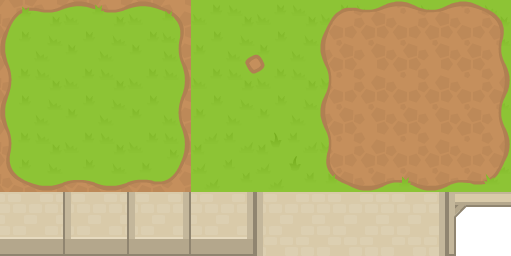
Using an atlas also has the advantage of naturally assigning every tile an index. This index is perfect to utilise every bit the tile identifier when creating the tilemap object.
The tilemap data structure
Information technology is common to group all the information needed to handle tilemaps into the same data structure or object. These data objects (map object instance) should include:
- Tile size: The size of each tile in pixels beyond / pixels down.
- Paradigm atlas: The Image atlas that will exist used (one or many.)
- Map dimensions: The dimensions of the map, either in tiles beyond / tiles down, or pixels across / pixels downwards.
- Visual grid: Includes indices showing what type of tile should exist placed on each position in the grid.
- Logic grid: This can exist a collision grid, a path-finding grid, etc., depending on the type of game.
Notation: For the visual grid, a special value (usually a negative number, 0 or null) is needed to represent empty tiles.
Square tiles
Square-based tilemaps are the nigh simple implementation. A more generic case would exist rectangular-based tilemaps — instead of square — only they are far less common. Foursquare tiles allow for two perspectives:
- Top-down (like many RPG's or strategy games like Warcraft two or Final Fantasy'southward globe view.)
- Side-view (like platformers such as Super Mario Bros.)
Static tilemaps
A tilemap tin can either fit into the visible screen surface area screen or exist larger. In the start case, the tilemap is static — it doesn't need to be scrolled to be fully shown. This case is very common in arcade games like Pacman, Arkanoid, or Sokoban.
Rendering static tilemaps is easy, and can be done with a nested loop iterating over columns and rows. A loftier-level algorithm could be:
for ( var column = 0 ; cavalcade < map.columns; column++ ) { for ( var row = 0 ; row < map.rows; row++ ) { var tile = map. getTile (column, row) ; var x = column * map.tileSize; var y = row * map.tileSize; drawTile (tile, x, y) ; } } You tin read more almost this and run into an example implementation in Square tilemaps implementation: Static maps.
Scrolling tilemaps
Scrolling tilemaps only prove a small portion of the globe at a time. They tin can follow a graphic symbol — like in platformers or RPGs — or let the player to control the camera — similar in strategy or simulation games.
Positioning and camera
In all scrolling games, we demand a translation between world coordinates (the position where sprites or other elements are located in the level or game earth) and screen coordinates (the bodily position where those elements are rendered on the screen). The world coordinates can exist expressed in terms of tile position (row and column of the map) or in pixels across the map, depending on the game. To be able to transform world coordinates into screen coordinates, we demand the coordinates of the camera, since they determine which section of the earth is being displayed.
Here are examples showing how to interpret from earth coordinates to screen coordinates and dorsum once more:
// these functions assume that the camera points to the top left corner function worldToScreen ( x, y ) { return { x : x - camera.x, y : y - camera.y} ; } role screenToWorld ( x,y ) { return { x : 10 + photographic camera.x, y : y + camera.y} ; } Rendering
A trivial method for rendering would simply exist to iterate over all the tiles (like in static tilemaps) and depict them, subtracting the camera coordinates (like in the worldToScreen() example shown in a higher place) and letting the parts that fall outside the view window sit there, hidden. Drawing all the tiles that tin non exist seen is wasteful, however, and can accept a toll on performance. Only tiles that are at visible should be rendered ideally — meet the Performance section for more ideas on improving rendering performance.
You can read more most implementing scrolling tilemaps and see some instance implementations in Square tilemaps implementation: Scrolling maps.
Layers
The visual grid is oftentimes made up of several layers. This allows the states to have a richer game world with fewer tiles, since the same paradigm tin be used with different backgrounds. For instance, a stone that could appear on superlative of several terrain types (similar grass, sand or brick) could exist included on its own separate tile which is so rendered on a new layer, instead of several rock tiles, each with a different groundwork terrain.
If characters or other game sprites are drawn in the center of the layer stack, this allows for interesting effects such as having characters walking behind trees or buildings.
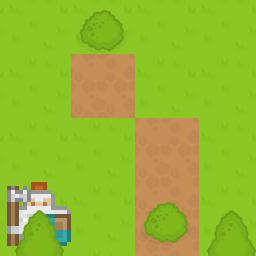
The following screenshot shows an instance of both points: a character appearing behind a tile (the knight actualization behind the summit of a tree) and a tile (the bush) being rendered over dissimilar terrain types.
The logic grid
Since tilemaps are an actual grid of visual tiles, information technology is common to create a mapping between this visual grid and a logic filigree. The most mutual example is to utilise this logic grid to handle collisions, but other uses are possible every bit well: character spawning points, detecting whether some elements are placed together in the right way to trigger a sure action (similar in Tetris or Bejeweled), path-finding algorithms, etc.
Isometric tilemaps
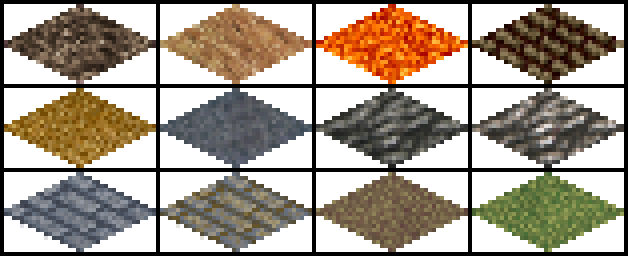
Isometric tilemaps create the illusion of a 3D environment, and are extremely popular in 2D simulation, strategy, or RPG games. Some of these games include SimCity 2000, Pharaoh, or Final Fantasy Tactics. The below image shows an example of an atlas for an isometric tileset.
Performance
Cartoon scrolling tile maps can take a toll on performance. Ordinarily, some techniques demand to be implemented so scrolling can be smooth. The start arroyo, as discussed above, is to simply depict tiles that volition be visible. But sometimes, this is not enough.
One simple technique consists of pre-rendering the map in a canvas on its own (when using the Sail API) or on a texture (when using WebGL), so tiles don't demand to be re-drawn every frame and rendering tin be done in only one blitting operation. Of course, if the map is large this doesn't actually solve the problem — and some systems don't have a very generous limit on how big a texture tin be.
1 mode consists of drawing the section that will be visible off-canvass (instead of the unabridged map.) That ways that every bit long as there is no scrolling, the map doesn't need to be rendered.
A caveat of that arroyo is that when in that location is a scrolling, that technique is not very efficient. A better way would be to create a canvas that is 2x2 tiles bigger than the visible area, so at that place is one tile of "bleeding" effectually the edges. That means that the map only needs to be redrawn on the canvas when the scrolling has advanced one full tile — instead of every frame — while scrolling.
In fast games that might still not exist enough. An alternative method would be to carve up the tilemap into big sections (like a total map carve up into 10 ten 10 chunks of tiles), pre-render each ane off-sheet and and then treat each rendered section as a "big tile" in combination with one of the algorithms discussed above.
See also
rutherfordrestroulner62.blogspot.com
Source: https://developer.mozilla.org/en-US/docs/Games/Techniques/Tilemaps
0 Response to "How Many Different Tile Positions Do I Need to Make a Pixel Art Tileset"
Post a Comment